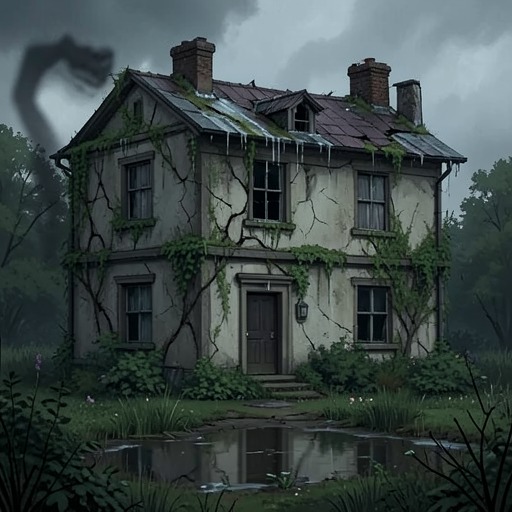
The Bramford will change from a bad house to a good house
Rosemary's BabyThe Bramford will change from a bad house to a good house is the hopeful prediction Edward Hutchins sends Rosemary Woodhouse and Guy Woodhouse when they move into the apartment. It turns their new address into a wager: that a place burdened by menace might be transformed by the life a couple builds there. The novel gives the phrase warmth and domestic promise, then places that promise against evidence that the house’s danger is built into its history and even its walls.
Origin and Meaning
Rosemary and Guy had signed a lease on a five-room apartment on First Avenue when they learned that a four-room apartment in The Bramford had become available. Old, black, and elephantine, the building was known for its high-ceilinged apartments, fireplaces, and Victorian details; the couple had been on its waiting list since their marriage, though they had eventually given up hope of getting in. The phrase’s transformation is therefore not a change of address from an obviously bad dwelling to an obviously good one. It imagines that the residents themselves can alter the meaning of a place already marked by unease.
Before the move, Rosemary offers a picture of what a good house might be: a place where people fall in love, marry, and have babies. Guy adds the possibility of becoming stars. Hutchins answers that such houses probably exist, but it is the bad ones that attract publicity, and urges the couple to look for a good house instead of The Bramford. The exchange gives his later message a pointed tenderness: he has heard their hope for an ordinary, successful home life, even as he doubts the building they have chosen can provide it.
The Moving-Day Promise
On Friday, August 27, Rosemary and Guy move into The Bramford. Among their gifts, Guy’s agent sends a small potted plant, while Hutchins sends a telegram: “The Bramford will change from a bad house to a good house when one of its doors is marked R. and G. Woodhouse.” The imagined sign on the door makes the couple’s names a kind of blessing. A private home, made theirs through marriage and daily acts of settling in, might counter the building’s reputation.
That hope is grounded in the tangible work of making an apartment livable. Rosemary hangs curtains, arranges a Victorian glass lamp, and turns four boards in the hall closet into linen shelves with gingham contact paper. The phrase’s idea of renewal thus rests not on a dramatic renovation but on ordinary acts of care: furnishing rooms, organizing household things, and giving an old apartment the marks of a new family.
A House That Resists Its Recasting
The reassuring vision is shadowed by the building’s history. Going to the basement laundry room, Rosemary remembers Hutchins’s warnings and the dead baby wrapped in newspaper that had been found there not long before. The service elevator creaks and trembles; the brick passageways carry distant footsteps and the thud of unseen doors. The domestic routine of washing clothes takes place inside an environment that keeps recalling violence and concealment. The house’s badness is not merely a story told about it; it intrudes into the spaces its residents use every day.
Later, when Rosemary concludes that there must be a secret way between her apartment and Minnie Castevet and Roman Castevet’s, her own household improvements become part of the means by which she uncovers it. She removes the gingham-covered shelves from the linen closet and notices that the paint along the back panel is broken. Pressing it open reveals a hidden closet and a keyhole looking toward a curio cabinet in the Castevets’ apartment; the door itself opens into their hallway. The very closet she had made neat and domestic conceals a passage through which the apartments are connected.
Irony and Significance
The phrase does not prove that Hutchins’s hope was foolish; it makes the contrast between the wished-for home and the actual one increasingly stark. The apartment has a door marked with the couple’s names in spirit, and Rosemary has worked to make its rooms hers. Yet the hidden opening exposes how little security that domestic ownership guarantees. When she enters the Castevets’ apartment, she finds distant voices but no crib and no baby. The discovery turns the home’s apparent separation from its neighbors into a physical deception.
As a recurring idea, the prediction measures the distance between a house’s comforting surface and what its architecture permits. Hutchins imagines that love, marriage, and family might make The Bramford good; the concealed passage reveals that the building can instead compromise the boundaries on which a private household depends. The expression remains memorable precisely because its promise is so simple—and because the novel makes the reader watch that promise fail to protect the people whose names were meant to change the house.